

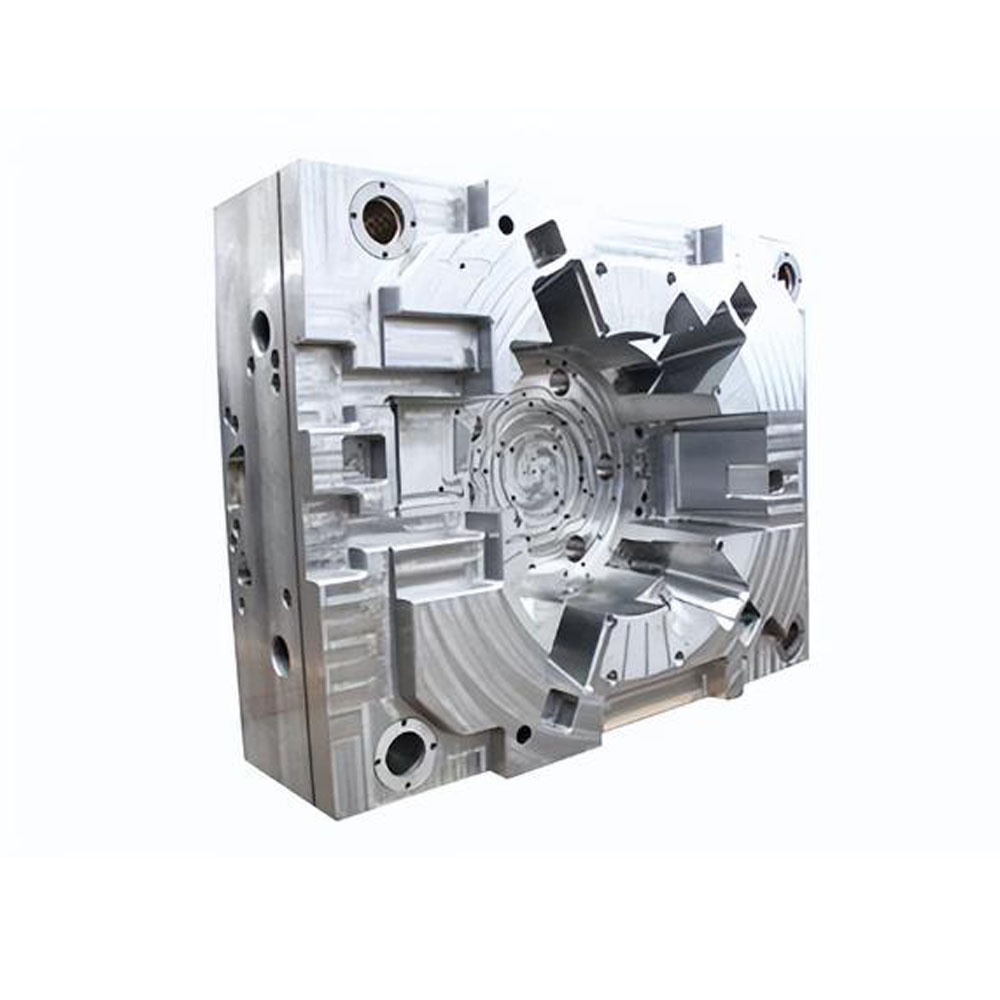
Products Description
Standard Processing Steps for Electromagnetic Stove Mold Bases
- CuttingUse a sawing machine to cut steel plates of standard specifications into rough blanks of the required dimensions.
- Rough Milling (Face Milling and Side Milling)Mill the six surfaces of the plate (mainly the reference surfaces) flat on a gantry milling machine, roughing out the basic shape and removing most of the machining allowance.
- Drilling Lifting Holes/Process HolesDrill screw holes (lifting holes) and reference pin holes on a drilling machine for hanging, handling, and positioning in subsequent processes.
- Rough Cavity Machining (Roughing)Use a roughing machine or gantry milling machine to preliminarily process the mold frame, guide pin and bushing holes, return pin holes, and other cavity structures on the mold plate, leaving a uniform finishing allowance for all areas requiring machining.
- Heat Treatment (Tempering)【Key Process】 Perform tempering treatment (quenching and high-temperature tempering) on the roughly machined plate. The purpose is to eliminate internal stresses generated during rough machining, uniformly improve the comprehensive mechanical properties (strength, toughness) of the steel, and provide a stable material condition for subsequent finishing.
- Precision Grinding of Reference SurfacesAfter heat treatment, the plate undergoes slight deformation. This process is performed on a precision grinding machine to grind the two most critical reference surfaces (typically A and B faces) to achieve extremely high flatness, surface finish, and precise thickness, providing the sole and accurate positioning reference for all subsequent finishing.
- Finish MillingPositioning with the ground reference surfaces, perform finishing on a gantry milling machine or precision milling machine for the four sides of the mold frame, parting surface, stops, slider grooves, etc., ensuring verticality, parallelism, and dimensional accuracy meet drawing requirements.
- CNC MachiningFor complex shapes that cannot be completed by finish milling (such as irregular curved surfaces, deep cavities, 3D runner channels, angled lifter holes, etc.), use computer programming to perform precision milling on a machining center (CNC).
- Drilling and TappingProcess all screw holes, ejector pin holes, water channel holes, guide pin holes, etc., and perform tapping. This process is typically completed on a high-precision radial drill or CNC drilling machine.
- Bench WorkPerform manual finishing, including chamfering and deburring all edges and corners, marking part numbers in specified locations, assembling bushings, pins, and other standard parts, and conducting water channel flow tests.
- Final InspectionUse measuring tools such as coordinate measuring machines, height gauges, and calipers to conduct a full inspection of all critical dimensions, hole position accuracy, and flatness, ensuring compliance with the design drawings.
- Assembly and PackagingClean and assemble all components, such as the front and rear mold frames, guide pins, return pins, and ejector plates, apply anti-rust oil, fasten securely, and package for shipment.
Hello, and welcome to learn about Changhui Company.
We are a research, development, and production supplier deeply specialized in the field of induction cooker mold bases, dedicated to providing mold makers with high-precision and high-stability mold base solutions. Leveraging our deep understanding of industry needs and continuous technological investment, we have become a trusted long-term supplier for numerous partners.
Our Core Strengths
- Scalable Team & Production Capacity: With over 100 employees and an average monthly output exceeding 8 million, we possess strong large-scale delivery capacity, ensuring stable lead times.
- Advanced Equipment Assurance: Equipped with over 60 production and processing machines, including 35 advanced CNC machining centers. Our large-scale equipment offers a machining travel of X3500mm / Y2500mm / Z1500mm. Our specialized deep hole drilling machines can handle water line holes up to 1450mm deep, expertly addressing the complex cooling channel challenges in induction cooker mold bases.
- Professional Technical Support: A dedicated team of over 30 engineering R&D personnel and more than 60 CNC technicians provides solid technical support throughout the entire process, from evaluation to delivery.
- Relentless Pursuit of Quality: We use custom mold steel known for its high hardness, corrosion resistance, and excellent surface finish. All steel materials are naturally aged for 90 days to relieve internal stress and must pass spectrographic analysis and flaw detection testing before being put into production, ensuring the long-term stability and lifespan of the mold base from the source.
Why Choose Changhui?
- Reliable Precision: The combination of advanced equipment and a professional team ensures machining accuracy, laying a solid foundation for the final product's molding quality.
- Stable Delivery Time: Our scalable production capacity, coupled with a mature supply chain management system, guarantees on-time order fulfillment.
- Expertise in Complex Structures: Our specialized equipment and accumulated process expertise enable us to efficiently and accurately handle complex core structures like cooling systems in induction cooker mold bases.
About Mold Bases
A mold base, also known as a mold frame, is the skeleton and foundational structure of a mold. It is used to support and secure all other components of the mold (such as cores, cavities, sliders, ejector pins, etc.). Its quality directly determines the stability and precision of the entire mold set.
If you require custom induction cooker mold bases, we are ready to assist. Please provide your drawings or specific requirements. Our engineering team will promptly evaluate them and provide an optimized solution along with a competitive quotation.